I was eating lunch with my Chinese host family today and I suddenly realized how different eating is in China. I began to analyze all of the differences and found that there are many things that could be considered quite strange in America.
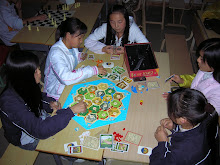
Chinese food is almost always served 'family style.' At larger tables a lazy Susan will slowly revolve and anyone can take what they want. At my host family's table, however, this is not needed. People will reach across the table with their own chopsticks and take a little of what they want.
The utensils are typically chopsticks and a bowl. Bones or other inedible parts of the food can either be thrown on the ground (outside restaurants), put directly on the table (as in my home), or placed on the extra small plate next to your bowl (as inside restaurants). The bowl has three basic positions: on the table, in your hand, and against your lips. Eating with a bowl to your lips is done for soup and the last bit of rice in the bowl. In addition to having the bowl at your mouth, chopsticks sweep into the bowl and pull out the last grains of rice.
If the rice comes at the beginning of the meal it becomes saturated with the flavors and oils of the foods eaten throughout the meal. This allows it to take on other flavors. When eating so much rice, this is preferable because I will typically eat rice with chopped pickled green beans to give it more flavor (one can only eat so many pickled green beans).
8.31.2007

8.30.2007
mashaji
In bookish Chinese, 'anmo' is massage. The two parts 'an' and 'mo' are distinct characters related to massage. In colloquial Chinese, however, sounds are taken from English to produce something similar in Chinese: 'mashaji' or, literally, horse kill chicken. After learning some vocabulary for haircuts and massages today, we persuaded our teacher to take us for our last class. In the morning we walked to a haircutting place and a few people got haircuts. During the afternoon we took a bus to get massages. These were amazing. They lasted one hour and were very deep massages. By the end I was very relaxed. Actually, I felt a little like an old rug after being dusted with a swinging broom. Overall the massage was very nice, but the best part was the price: $3.
8.27.2007


Vegetable/Fruit Market
There is a vegetable, fruit and meat market near my house. Sometimes I will walk through and talk to people which is quite difficult and often impossible (because they speak Sichuanhua not Mandarin). The people are friendly and patient and usually happy to see Americans ("hello" is a word I hear a lot). Here are a few pictures from this evening. I took more but they are on another camera. They will be added soon.


8.26.2007
Anshun
I spent the last week in Anshun. When we arrived, officials from the college brought us to see our apartments. I live on the 5th floor of one building and Bethany lives on the 2nd floor of another building. We were then collected for a meeting with the vice president, foreign affairs people, teachers and, of course, a translator. Our translator, Charley, spent the week helping us get accustomed to life in Anshun. It is a small town by Chinese standards (we found out there are about 1/2 million people) and the college is set about 30 minutes away in the country. Charley helped us with everything. We ambled along and quietly mentioned things: "Bank account?" Done. "Good place to eat?" Let me introduce you to the owner. "Bus lines, maps, sites, attractions, how-tos, why is thats, etc..."
Early in the week I began to feel dizzy and I had trouble walking without feeling a little ill. My symptoms got worse and I collected more throughout the week (sore throat, chest pain, coughing, runny nose, sore muscles, nausea) and I called the medical office in Chengdu during my visit. The second half of the week I was in my apartment, drinking liter after liter of water and studying Chinese. I am better now! Unfortunately, I believe Bethany may now be sick...
We found a batik shop that does batiks by hand. Some of them take weeks to make and they are huge. The shop was dedicated more to the 'art' of creating the batiks than to making money because they take the time to make the batiks by hand rather than running cloth through a printer. I imagined a shop like this existing in America and I could only see dollar signs. I can't imagine a city without a traditional Chinese batik shop.
Anshun's outskirts are defined by green, hilly farms and small villages. We walked up through a very poor village and around a reservoir. The people are very friendly and warmly welcome a smile accompanied by a "Ni hao!" On and around campus I am reminded, perhaps, of the foothills around the Cascades or the small drive from Forest Grove to Gales Creek. From the window in the back of my apartment I can see two large dormitory buildings, a track and soccer field, and basketball courts, all signs that this will be transformed into a college campus once the students arrive. In the middle of my reverie something catches my eye: a man with a straw hat drives a family of water buffalo across the basketball courts and they move slowly, swinging their tails as they go.
The train on the return trip was painful. We left Anshun at 7 p.m. and arrived in Chengdu at 5 p.m. the next day. The trip was long, hot, sweaty, and cramped. The only thing that saved me from insanity was the clickedy-clack of track ties which repeatedly put me to sleep. The green hills disappeared overnight and then farms made way for buildings. We were back "home." Enjoy the photos.

Water buffaloes

Batik Shop

Rural Anshun

Fishermen

Children
Early in the week I began to feel dizzy and I had trouble walking without feeling a little ill. My symptoms got worse and I collected more throughout the week (sore throat, chest pain, coughing, runny nose, sore muscles, nausea) and I called the medical office in Chengdu during my visit. The second half of the week I was in my apartment, drinking liter after liter of water and studying Chinese. I am better now! Unfortunately, I believe Bethany may now be sick...
We found a batik shop that does batiks by hand. Some of them take weeks to make and they are huge. The shop was dedicated more to the 'art' of creating the batiks than to making money because they take the time to make the batiks by hand rather than running cloth through a printer. I imagined a shop like this existing in America and I could only see dollar signs. I can't imagine a city without a traditional Chinese batik shop.
Anshun's outskirts are defined by green, hilly farms and small villages. We walked up through a very poor village and around a reservoir. The people are very friendly and warmly welcome a smile accompanied by a "Ni hao!" On and around campus I am reminded, perhaps, of the foothills around the Cascades or the small drive from Forest Grove to Gales Creek. From the window in the back of my apartment I can see two large dormitory buildings, a track and soccer field, and basketball courts, all signs that this will be transformed into a college campus once the students arrive. In the middle of my reverie something catches my eye: a man with a straw hat drives a family of water buffalo across the basketball courts and they move slowly, swinging their tails as they go.
The train on the return trip was painful. We left Anshun at 7 p.m. and arrived in Chengdu at 5 p.m. the next day. The trip was long, hot, sweaty, and cramped. The only thing that saved me from insanity was the clickedy-clack of track ties which repeatedly put me to sleep. The green hills disappeared overnight and then farms made way for buildings. We were back "home." Enjoy the photos.

Water buffaloes

Batik Shop

Rural Anshun

Fishermen

Children
8.18.2007
你好朋友们!
你们好,
明天我要看看我以后的地方。我们要认识很多人。
下个星期我要告诉你们。
谢谢,
欧雷
Hello Everyone,
Tomorrow I will go to see the place I will work. I will meet many people.
Next week I will tell you all about it.
Thanks,
Ou Lei
明天我要看看我以后的地方。我们要认识很多人。
下个星期我要告诉你们。
谢谢,
欧雷
Hello Everyone,
Tomorrow I will go to see the place I will work. I will meet many people.
Next week I will tell you all about it.
Thanks,
Ou Lei
8.17.2007
Site Visits
We are going to leave for site visits tomorrow. Since I will be in a "rural" location for a week, I may not be doing much communicating. We all have hard sleepers because it takes so long to get there; my train will take about 18 hours to get there (according to my ticket, so maybe longer). This led me to thinking: "What takes 18 hours to complete?" I figured 8 hours of sleeping and 10 hours of preparing for my Language Proficiency Interview (LPI) through rote memorization of dialogues. Yippee.
We were given a packet of information that will keep us very busy over the next week at site. That's because most of the packet is an array of empty fields to be filled in as we learn the information. It is like a great big scavenger hunt to help us better understand the place we will spend the next two years of our lives. Questions such as, "What are two popular local Chinese dishes?" did not escape the person who generated the packet. All of the questions are designed to help us begin thinking about integration, community, responsibilities, relaxation, etc.
Now I will go to bed. Goodnight.
We were given a packet of information that will keep us very busy over the next week at site. That's because most of the packet is an array of empty fields to be filled in as we learn the information. It is like a great big scavenger hunt to help us better understand the place we will spend the next two years of our lives. Questions such as, "What are two popular local Chinese dishes?" did not escape the person who generated the packet. All of the questions are designed to help us begin thinking about integration, community, responsibilities, relaxation, etc.
Now I will go to bed. Goodnight.
Subscribe to:
Posts (Atom)

 Posts
Posts