9.15.2008

Ping Pong

The outdoor Ping Pong tables have finally been replaced. Now instead of 8 tables there are 14, inviting more people to play without having to stand in line. It has been nice to play there, but every time I went out I had to wonder: "What's with this fence?" At first it didn't seem to be a problem because the gate was wide open. Today, an official holiday in China, the gate was shut and locked. It prompts all sorts of questions:

1. Are they locking the gate to keep the tables from being stolen?
2. Are they worried that people will play too late?
3. Is there even a real reason for this?

I will pursue these questions further during this semester. It seems that stolen tables is highly unlikely, given they are bolted down. The worry that students will play too late is unfounded because there is inadequate light to support a game. The final question probably leads more to the truth. Someone, somewhere, has made a decision. Whether that decision was based on reason or not is entirely unclear. Perhaps there was some money allocated for the Ping Pong reconstruction and it was not entirely used. The extra money was then spent on a fence so that all of the money could be used. This is based on reason, though it doesn't seem very fiscally responsible.

Instead of building a fence, why not install four tall lampposts to provide light throughout the courts? I could play all night.

What do you think? Why have they installed the fence?


9.11.2008

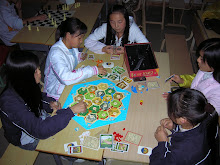
Game Club

In an effort to take on more responsibility this year I have decided to start a game club. A game club provides opportunities for students to read and speak English, improving their overall communication skills (especially when a dispute is settled by referring to the direction booklet!). This is a chance for students to practice English in a low-stress environment, reducing their inhibitions to speak naturally.

I have a couple of chess sets and playing cards to get me started, but I need some help through donations of games. I would like to get some more "board" and "strategy" games, specifically (1) Settlers of Catan and (2) Monopoly, but any board games are welcome. Anyone willing to send games can contact me about this via email (fn0112358@gmail.com).

Also - if someone has a connection with someone who works at a game store or company and they might be able to get a deal please let me know.

Many, many thanks.


9.10.2008

广播 (Broadcast)


Perhaps you can't see what is attached to the edge of this building and that's OK because I'm going to tell you: they are loudspeakers - part of a public address (PA) system on the campus. These are used thrice daily to give news, celebrate birthdays, and make local announcements. They are useful for waking eager students up in the morning. However, they also wake not-so-eager students who don't have class until 10 a.m. They were used a week after the earthquake to project the sounds of that terrible day while students stood silent and motionless. They are probably the most normalizing aspect of my life here because they unconsciously tell me what time it is (either between 6:30 and 7:00, 12:00 and 12:30 or 6:00 and 6:30). The fact that I can barely understand the cracklings of the thin voice is ok with me, I am merely content that it plays regularly.

There has been talk that the foreign teachers will take an active role in these broadcasts. Within a few weeks we will be invited to give a short presentation in English about a topic of our choosing (I will chose "How to Study English"). After our presentation they will open a single hotline for students to ask follow-up questions. I'm already looking forward to the first phone call:

Caller: Hallo, I jab schion oregn echier - hwn you say zhat pelo, hao do you mine?
Translator: Excuse me, would you please speak Mandarin?
Caller: Oh, shahry, [more unintelligible speech]
[several minutes of back and forth]
Translator: Oh, what he wants to ask is, "How can [he] study English better?"
Me: Ummm... I just gave a presentation about that.
Translator: [Obviously confused about what to say] Oh.

And so on.

Actually, it will go much smoother than this (probably), but I am always suspect of things that have been organized in the Chinese fashion in Guizhou Province. Typically it means that either some or a lot of preparation has been done, but there are always wild cards that make one think, "Did they even begin to think about this event; where is the organization?"

I'm excited for this broadcast. My speech will have three main tenets: Practice, practice, practice.

English Lessons

In one of my most successful lessons so far, my students got the opportunity to express themselves as they were and as they are.

I broke the class into several groups and gave each group a large piece of paper and markers. On the paper they were asked to represent themselves (some groups represented the typical primary school student, some did middle/high school, and others did college). The assignment was to draw a picture of a person who represented this group and write words to express your life at the time.

The results were eye-opening. Elementary representations included a school uniform and the thoughts that everything was wonderful: many friends and much happiness. The middle/high school representations showed students loaded down by books and included such words as "studying," "homework," and "serious." The college representations included cell phones and cool clothes. Words like "friends," "chatting," and "no money," covered these posters.

One of the students came to me and asked, "How do you say it in English when you say you are poor but you really are not poor." I tried to think and couldn't come up with anything so I just said, "Maybe we would just say 'liar'." Then she noted the poster that said, "no money." She said, "They write 'no money' on their poster, but I know these boys and they have money." It was interesting how this activity became different things for different people. Their poster helped her to practice her Oral English because she was personally interested in this dissonance. The affront became something that would help connect English phrases and words in her brain.

For other students the results were different. One student continually spoke in Chinese, despite repeated warnings. It took the threat of "Kou Fen," or, taking points, to finally convince her that English would be the appropriate means for communication in this Oral English class.

It was an activity that offered many chances to communicate with one another. It was interesting to most students, mostly because it was connected to their own lives. Like all experiences in class I told my students, "It's what you make of this time that will determine how good your Oral English becomes. Those of you who try will improve."

If you have something that would help my students practice their Oral English in a fun or unique way, please let me know. I don't know exactly what that might be, but the first thing that jumps into my mind are puppets!

Cheers!

The Freshmen Arrive

These are exciting times on campus. The new students have mostly arrived, unpacked, and begun to look around at their new surroundings. The workers have been making a great effort to improve the buildings and environment of the campus. I passed the ping pong court on the way to the library yesterday and found 14 new tables in place of the 8 old ones. Happy day. The whole process reminds me of parent's weekend in college. The cafeteria only served the best foods that weekend and they even cut the grass on the quad. It's nice to see such eager faces again. Last year it was much the same until the incredible class load began to steal the life from many of my students.

Some of my students welcomed the new English Major students so they could help carry luggage. The sign says, "Foreign Language Department" or, literally, "Outside Language Department." (1)

The larger sign welcomes all students with the sentence, "Anshun College welcomes you!" (2)

The cell phone companies fought for business. It's really quite entertaining, especially when I pretend to be interested and they try to explain their calling plans. I don't even understand those in English. (3)


9.07.2008

My bookshelf

During my time here in China I have found a number of enlightening books on Chinese thought, culture, events, history and politics. The following is a list of my favorites with some information about why you might find it interesting. (* Means I really think you might like it)

If you have questions about what to read because you are interested in reading more about some aspect of China, just send me an email (fn0112358@gmail.com). There are also countless Newsweek articles in the online archive that cover a range of topics related to Chinese society and economy.

River Town*
Peter Hessler

This is the first book I read about China. I read it before I left and again since I have been here (it was two different books!). It resonates because the author was not only a Peace Corps China Volunteer, but the book specifically discusses his experiences volunteering in Sichuan.

Oracle Bones
Peter Hessler

This is somewhat a follow-up of River Town. It follows Hessler’s work while in Beijing after Peace Corps. The style is like River Town with a combination of Autobiography and Chinese History. It is very readable non-fiction about China and the history connected to Oracle Bones.

The Rape of Nanking*
Iris Chang

This is one of the most eye-opening books that helps to explain the relationship between common Chinese people today and the Japanese. This is an event that few Westerners know about; one would be wise to try and understand it better.

Individualism and Collectivism

Harry C. Triandis

This is a very well researched book about the differences between collectivist and individualist societies. It analyzes these two aspects from many different angles, though it can be a bit dry at times. This is for anyone who wants to know more about the social science of individualism and collectivism.

Encountering the Chinese*
Cornelius Grove

This is by far the most readable book about everyday aspects of modern Chinese culture. For anyone interested in basic differences between Chinese and Americans, this is a good place to begin.

Chinese Lessons*

John Pomfret

This was a wonderful autobiography about a man who studied in China. He tells the stories of his classmates, most of whom were directly influenced by the excesses of the Cultural Revolution. Very readable.


China Wakes

Nicholas D. Kristof and Sheryl Wudunn
I am just finishing this book and it has been worth the read. The chapters alternate writers (they are husband and wife). This is probably the most openly critical book I have read about China. Aspects of current problems in certain *ahem* autonomous regions are also alluded to throughout the book.

China (Cambridge Illustrated History)
Patricia Buckley Ebrey

This is an illustrated history of China’s History, covering everything. As such, it treats most topics rather superficially (as a High School History textbook might), but provides amazing photographs and maps to help illustrate the location of “China” throughout the dynasties.

A Bitter Revolution
Rana Mitter

Mitter covers the modern Chinese developments beginning with the events surrounding the movement of 1919 and continuing to the present day. This is a book more about the politics of China during this period. The author spends most of his time arguing that the May 4th movement of 1919 was the defining moment for modern China (from which all things have been influenced).